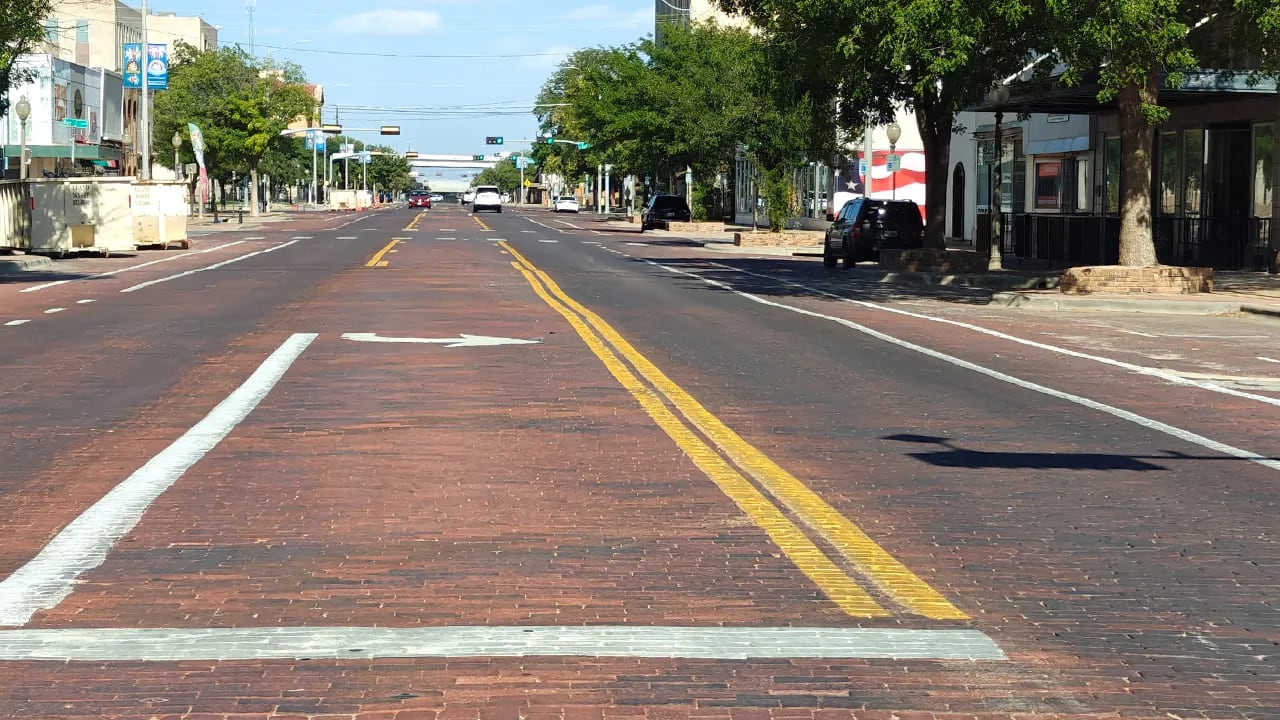
Lubbock has finally decided to solve our city’s most pressing crisis: having a street with actual historical character. This summer, the city is officially moving forward with its plan to rip up the historic brick on Broadway between Avenues Q and E. Because why enjoy a unique, bumpy piece of local heritage when you can replace it with the soul-crushing, sterile smoothness of gray concrete? Don’t worry, though—the intersections will feature “modern brick pavers” to give a “nod” to history, which is exactly how I feel when I look at a plastic plant to remind myself of nature.
Of course, this wouldn’t be a true West Texas infrastructure miracle without a logistical nightmare attached. City Engineer John Turpin promises an agonizing two-year, four-phase construction circus. They are doing a “split-phase” setup, meaning they’ll tear up one lane at a time, forcing drivers into one-way detours until at least 2028. To ease our collective panic, Turpin went on the record to promise that the contractor won’t just “show up, tear up the street, and then leave.” Oh, whew! What a relief. Because if there is one thing Lubbock road construction is known for, it’s finishing exactly on time with zero abandoned traffic cones.
Let’s talk about the math, because it wouldn’t be a local government project if it didn’t cost more before a single shovel even hits the dirt. The project was originally supposed to cost $16 million under the 2024 road bond, but surprise! It’s already ballooned to $17.3 million. Luckily, the city has a “contingency fund” for when things inevitably cost more than they said they would. To make matters better, the city is outsourcing the job to Ti-Zack Concrete, a company based out of Minnesota. Because when I think of experts who truly understand the blistering, asphalt-melting heat of a Lubbock summer, I naturally think of America’s freezing north.
And what is the glorious fate of the actual, historic bricks that have survived decades of traffic? The city plans to lovingly transport them to their grand new home: the Canyon landfill site. Nothing screams “we value our local history” quite like throwing it into the literal dump. Turpin says they’ll try to preserve as many as they can during the demolition, but let’s be real—most of them are destined to become very expensive paperweights or landfill filler.
But hey, look on the bright side: in two years, we’ll have a perfectly smooth, completely personality-free road to sit on while we wait in traffic. What could possibly go wrong?
Source: